

- 011414 signs LOI with JR Energy (Korea) for SiNTL.
- 02SiNTL-coated Si nanoparticles in graphite to boost density.
- 03Evaluation aims at a manufacturing deal and scale-up.
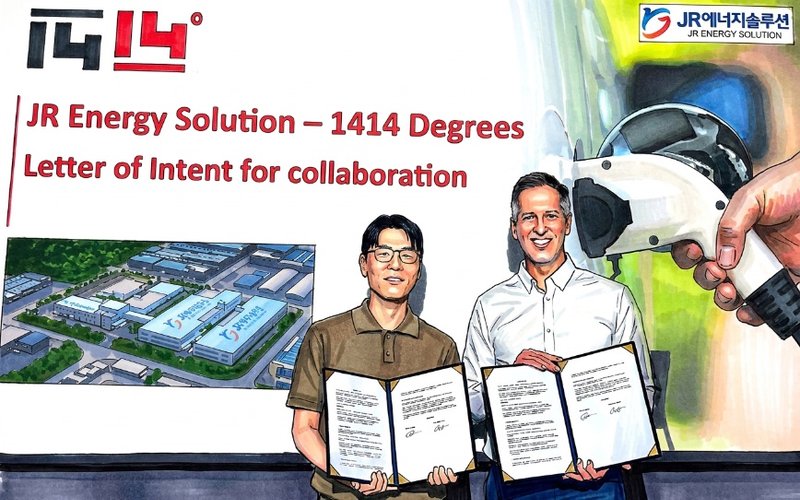
1414 Degrees (ASX: 14D) has signed a letter of intent with South Korean battery electrode and cell manufacturer JR Energy Solution to co-develop batteries incorporating its SiNTL silicon anode material designed to increase lithium-ion battery energy density.
The parties will evaluate SiNTL material samples, develop and optimise electrode formulations, manufacture electrodes and cells, and undertake half-cell and full-cell performance testing to assess key battery performance characteristics including capacity, energy density, cycle life, and rate capability.
Developed at George Washington University (GWU), the SiNTL process applies a thin aluminium coating to silicon nanoparticles in a single, low-temperature step using a one-pot method with no hydrogen fluoride or silane and no new manufacturing infrastructure required.
The aluminium coating forms in-situ during synthesis, enhancing conductivity and oxidation resistance, and the coated nanoparticles are then embedded into a graphite matrix that constrains the volume expansion that typically degrades silicon anodes, resulting in an air- and water-stable material compatible with existing anode production lines.
Establishing a Technical Base
The results of the evaluation will establish the technical base for a definitive manufacturing agreement covering scale-up and production of SiNTL-based battery cells at JR Energy’s facilities.
1414 Degrees and JR Energy will also consider the commercial and manufacturing terms for a definitive agreement that could support larger-scale production as SiNTL progresses through qualification and customer adoption.
1414 Degrees recently commenced the scale-up phase of its SiNTL silicon anode program as it moves toward commercial engagement with battery manufacturers and potential original equipment manufacturer (OEM) customers.
Development work is continuing at GWU, while agreements are in place with Energia-2000 for unmanned aerial vehicle (UAV) applications and with Orbit Boy and Space Industries for space and satellite end-uses.
JR Energy could potentially provide electrode and cell manufacturing capabilities to support the development of application-ready batteries for these programs.
Key Manufacturing Pathway
1414 Degrees chief technology and operations officer Dr Peter Yaron said the collaboration offered access to third-party electrode and cell development capability, while providing a potential route to scaled battery cell production.
“This agreement adds an important manufacturing pathway as we progress SiNTL toward real-world applications and commercialisation,” he said.
“We already have pathways into the UAV, defence, and space markets—access to versatile electrode and cell manufacturing capability in South Korea gives us another option to support those programs and scale our production as demand develops.”
JR Energy chief executive officer Duke Oh cited growing demand from defence and robotics customers seeking high-performance battery solutions and diversified manufacturing supply chains.
Global Market Opportunity
International Energy Agency statistics show the global lithium-ion battery market exceeded US$150 billion in 2025.
China manufactured well over 80% of all batteries globally, with Korea and Japan the only other countries with notable mid-stream battery industries.
Industry research projects the silicon anode battery market will grow from approximately US$400 million in 2025 to US$25.8 billion by 2035, representing a compound annual growth rate of 51.7%.
The market for silicon anode materials is forecast to expand significantly as battery manufacturers seek higher energy density.
Get the wire before the market opens.
The ASX small-cap stories that matter, filed before 9am AEST. Curated by the Small Caps desk.