
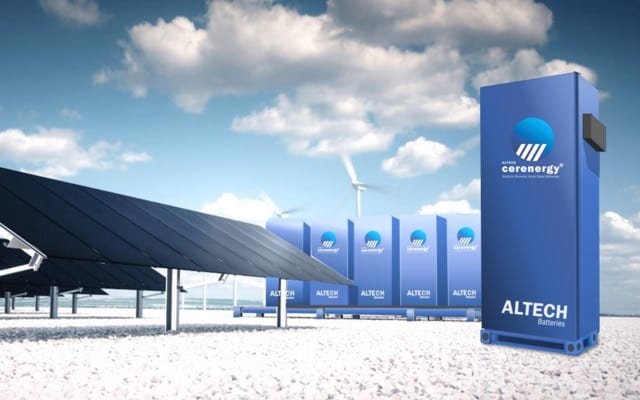
Altech Batteries (ASX: ATC) has called in Norwegian climate research specialists the Centre of International Climate and Environmental Research (CICERO) to assist with obtaining of ‘green’ accreditation for its CERENERGY battery and renewable energy project.
The Sodium Chloride Solid State technology uses sodium-chloride (table salt) as a key ingredient and is being developed by Altech to be a global grid battery storage option for the future.
CICERO, which is considered to be Norway’s leading climate research organisation, has been brought in to undertake an external assessment of CERENERGY environmental credentials.
This is not the first time Altech has engaged CICERO and its expertise in green credentials as the pair previously combined to obtain a “light green” rating for Altech’s Silumina anodes project.
Altech managing director, Iggy Tan, said the company’s background experience of working with CICERO provides it with confidence that it can be successful in obtaining green accreditation for CERENERGY.
“There is clearly an environmental advantage of the CERENERGY battery and proposed factory. Considering the GHG footprint evaluation conducted by independent groups, we anticipated from the outset that our batteries would be classified as ‘green batteries.’ We are currently in the official accreditation process.”
CERENERGY a strong rival to LIBs
Whilst lithium-ion batteries (LIBs) currently dominate the emerging grid storage sector, Altech believes that the addition of new “green” credentials will highlight the benefits of CERENERGY’s smaller carbon footprint.
The company says recent research has confirmed CERENERGY provides significant potential Greenhouse Gas Emissions (GHG) footprint advantages.
A new study conducted by the Sustainable Technologies Laboratory at Bochum University of Applied Sciences in Bochum, Germany, found that GHG emissions of CERENERGY batteries were significantly lower than that of the LIBs they elected to test.
The studies found that CERENERGY battery GHG emissions can range from 9.1 to 22.7 gCO2eq per kWh (grams of carbon dioxide equivalent per kilowatt-hour of electricity – with an average of 16 gCO2eq per kWh) discharged and consumed, compared to 31.3 gCO2eq for lithium-ion batteries and 122.1 gCO2eq for lead-acid batteries.
A life cycle assessment also found that CERENERGY batteries exhibit a GHG footprint at least 50% lower than that of lithium-ion batteries.
According to Altech, this aligns with its own findings as CERENERGY batteries, which employ sodium-chloride (common table salt) and nickel, do not rely on critical metals such as lithium, cobalt, copper, graphite, and manganese, which it says are associated with high GHG emissions from mining and extraction processes.
Renewable power plans also offer green benefits
Altech also highlighted the design of the CERENERGY 100 MWh battery plant in Saxony, Germany, which will be powered by renewable energy.
This includes the project’s tunnel kiln which will be powered by electricity instead of natural gas, enabling the utilisation of renewable power.
All heating systems within the plant have also been designed for renewable electrical heating and there will be no natural gas usage at all in the plant.
On site solar power generation
The design of the CERENERGY battery plant will also include photovoltaic panels on the roof space.
The plant employs multiple banks of 1 MWh GridPacks to store excess energy during the day for use during night-time hours to support the battery plant’s energy storage capabilities.
The 100 MWh plant will also include a recycling facility capable of recycling both off-specification battery units and returned battery units from the field.
ESG reporting program in place
Altech has also initiated a reporting process that has been designed to match the World Economic Forum’s Stakeholder Capitalism Metrics ESG Framework.
The primary objective is to showcase the existing on-the-ground efforts and green initiatives the company is undertaking.
Altech says it has been shown that 82% of retail investors express interest in investing in socially and environmentally responsible companies, with 9 out of 10 institutional investors also incorporating ESG factors into their investment decision-making processes.
